


UA Ruhr News Center
11. 11. 2026
Bridging Climates: German-American Pathways for Resilience and Climate Action
Bridging Climates: German-American Pathways for Resilience and
Climate Action
November 6, 2026 | New Jersey
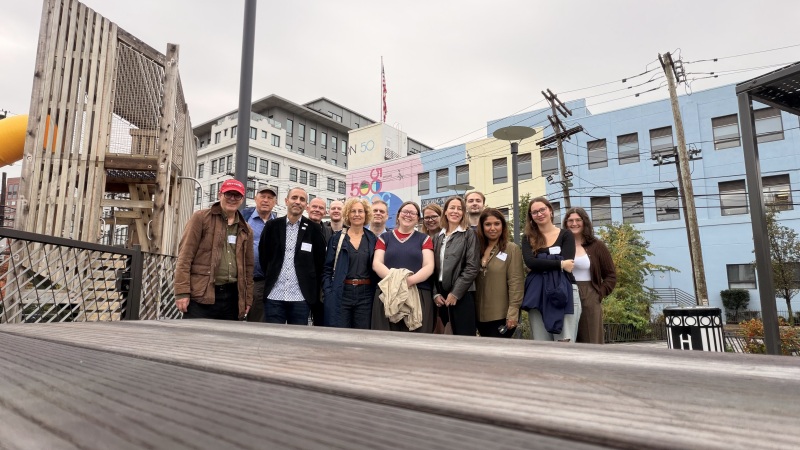
Bridging Climates: German-American Pathways for Resilience and Climate Action brought together German and American participants from universities, local government, urban planning, sustainability, and climate action for a day of site visits, exchange, and discussion focused on how communities can move from climate knowledge to implementation.
The New Jersey/New York region saw a major push for climate action after Superstorm Sandy flooded thousands of homes in October 2012. The all-day program linked this experience to today's international climate debate, including the COP31 UN Climate Change Conference, which begins on November 9 in Antalya, Türkiye.
Rather than approaching climate resilience solely as a technical or scientific challenge, the program examined the relationships between infrastructure, urban planning, public participation, research, policy, and local government. Throughout the day, a central question emerged: How can knowledge about climate risks and potential solutions be translated into action at the local level, before communities experience catastrophic events?
Seeing Climate Resilience in Practice
The day began in Hoboken, one of the most densely populated cities in the United States. Located directly on the Hudson waterfront, it was heavily flooded by Superstorm Sandy in 2012. Followed by this destruction of many houses the United States Department of Housing and Urban Development allocated $230 million to Hoboken as part of its Rebuild by Design initiative, adding levees, parks, green roofs, retention basins and other infrastructure to help the low-lying riverfront city protect itself from ordinary flooding and build a network of features to help Hoboken future-proof itself against subsequent storms.
The visit to Hoboken showed how a municipality facing significant flood risk has built climate resilience into public infrastructure and everyday urban life. Hoboken's network of resiliency parks combines stormwater detention with recreation, green space, mobility, and other community uses. Resilient City Park, built on a former industrial site, includes a large underground detention system, rain gardens, permeable surfaces, and stormwater reuse for irrigation. Other sites rely on underground detention basins and green infrastructure to manage large volumes of water while still working as neighborhood parks.
Participants also learned how smart sensors allow water levels within detention systems to be monitored and managed in coordination with sewer infrastructure. This enables water to be released when capacity becomes available rather than simply waiting until a storm has passed. The parks show that climate infrastructure does not have to be separate from public life. Designed for flood resilience, they also provide trees and vegetation, pedestrian space, and community amenities. Public consultation shaped these features, and the result is a mix of paddleball and basketball courts, dog parks, and playgrounds. Stephen Whitehouse (FASLA, AICP, Starr Whitehouse Landscape Architects and Planners PLLC), who designed Hoboken’sfirst Resiliency Park in 2017, and Mayor Emily B. Jabbour’s office Jennifer Gonzalez and Diane Goldsholl, who leads the city’s resilience initiatives, explained how scientific expertise, public policy, and local governance work together to protect communities and infrastructure.
At the same time, the discussion made clear that implementation is complex. High groundwater, existing utilities, contaminated or unstable soils, maintenance requirements, and the cost of major infrastructure all influence what municipalities can accomplish in spite of structural and fiscal limitations. Community participation is another important element: public consultation helps determine park features and amenities, illustrating the symbiotic relationship between technical climate solutions and the people / communities inhabiting and utilizing these spaces.
The Resiliency Park in Hoboken is proof of concept on three levels. Environmentally, the drainage system and smart sensors released stormwater in a controlled way, and the park area did not flood despite 61 major storm events, five tropical storms, and one hurricane. Socially, local residents visit daily, many community events have taken place in the park, and it has raised awareness of how floods work and why they are dangerous in the city. Economically, property values within a half-mile of the park have increased.
From Individual Projects to Regional Resilience
The conversation then widened from individual sites to land use and regional planning in New Jersey. Green Acres, farmland preservation, and Blue Acres illustrated different ways in which governments can protect land, limit future development, and respond to areas that flood repeatedly.
New Jersey established the Blue Acres Program as early as 1995 to fund land acquisition. After Superstorm Sandy and Tropical Storm Ida in 2021, the program was significantly expanded. It now focuses on buying out owners of private homes that were damaged by storms or storm-related flooding, or that may flood in the future. Participation is voluntary, so the program depends on close collaboration with homeowners to find ways for them to sell to the state and move out of harm's way.
The discussion of Blue Acres with Thomas Flynn, Floodplain Administrator, Woodbridge Township also revealed the difficult economic consequences of managed retreat. Buying properties in flood-prone neighborhoods can reduce future vulnerability, but it can also diminish a municipality's tax base and raise longer-term questions about how acquired land should ultimately be used and maintained. Communities with access to transit and opportunities forhigher-density development may be better positioned to compensate for these losses than municipalities with fewer development options.
Participants also noted how strongly many residents want to remain in homes where they have lived for decades, even though rising water threatens them regularly. Personal and cultural ties to place shape these decisions, and they limit how far buyouts alone can go.
The discussion also extended to transportation. Transit-oriented development and the relationship between rail infrastructure, density, land use, and municipal finances demonstrated that climate resilience cannot be considered independently of broader decisions about how regions grow.
Universities as Partners in Climate Action
At Rutgers University in New Brunswick, the discussion shifted toward the role universities can play in translating climate commitments into institutional and societal change.
The Rutgers Office of Climate Action described an approach that grew in part from student advocacy and now encompasses the university's goal of achieving carbon neutrality by 2040, alongside commitments to climate justice, equitable adaptation, and actionable scholarship. Sustainability efforts extend across campuses and operational units and include green building standards, climate action groups, sustainability metrics, and partnerships connecting research with policy.
The discussion underscored the potential for universities to operate not only as producers of climate research but also as conveners and partners for municipalities, government agencies, and communities. Participants identified opportunities for greater collaboration around technology transfer, community engagement, policy development, and education.
Interdisciplinary research emerged as particularly important. Engineering and technological solutions interact with biology, landscape design, public health, social science, human behavior, and democratic decision-making. Understanding these interactions is essential if climate solutions are to work not only technically, but also socially and politically.
Sebastian Schmuck, Sustainability Manager at the University of Duisburg-Essen, added a perspective from the Ruhr region, which has long experience in water resource management and river restoration. Alongside the university’s approach to municipal water and waste management, two water associations active in the region, the Emschergenossenschaft and the Lippeverband, work to preserve attractive river landscapes with intact water cycles for future generations. Founded more than 100 years ago, they operate their facilities safely and responsibly and plan and implement projects along the Emscher and Lippe rivers, guided by technical innovation, economic efficiency, and ecological sustainability. Facing water pollution, climate change, and a changing energy market, they also take part in state-level and European projects that develop new concepts for wastewater treatment, energy generation, and climate adaptation.
Local Government and the Challenge of Implementation
Experiences from Stamford added another municipal perspective. Climate resilience is being incorporated into the city's longer-term planning in response to coastal flooding, sea-level rise, increasingly intense rainfall, inland flooding, and extreme heat.
The discussion demonstrated how climate risks are also questions of equity. Research into urban heat, for example, has shown differences across neighborhoods, with denser and lower-income areas experiencing greater heat exposure. Responses such as expanding the urban tree canopy therefore have implications for both environmental resilience and quality of life.
Municipal tools including zoning, stormwater requirements, street-tree planting, sidewalks, green or solar roofs, and sustainability standards can gradually embed resilience into urban development. Yet local governments continue to confront a fundamental challenge: many of the measures necessary to protect critical infrastructure require substantial financial investment.
From Knowledge to Action
Across the day's discussions, several common themes emerged despite the different institutional and geographic contexts.
Climate resilience requires collective rather than individual action. Municipalities, universities, government agencies, researchers, communities, and other stakeholders each hold different pieces of the knowledge and authority necessary for implementation.
Participants also returned repeatedly to the relationship between public participation and the urgency of action. Community engagement is essential to democratic planning and to creating solutions that people support, but lengthy processes can make rapid infrastructure implementation more difficult. Finding ways to combine meaningful participation with the ability to act remains an important challenge.
The German-American exchange also highlighted the value of comparing approaches across different political and institutional systems. Recent flood events have accelerated resilience efforts in Germany, while examples from New Jersey and Connecticut demonstrated how municipalities are experimenting with infrastructure, planning, land-use regulation, and partnerships. Participants identified opportunities to continue examining which approaches can be transferred between contexts and which depend on particular local conditions.
Perhaps the strongest message of the day was the importance of acting before disaster forces action. Climate resilience cannot begin only after catastrophic flooding, extreme heat, or other climate impacts have occurred. Prevention requires investment, political commitment, public trust, and sustained cooperation across institutional boundaries.
The day concluded with a shared interest in deepening collaboration among universities, municipalities, researchers, and communities on both sides of the Atlantic. The discussionspointed toward opportunities for future research, student engagement, technology and knowledge transfer, and direct interaction between academic partners and local governments.
Bridging Climates demonstrated that transatlantic climate exchange is most valuable when it moves beyond comparing policies and toward learning from implementation: seeing what communities are doing, understanding the obstacles they encounter, and identifying where research and partnership can help turn climate ambitions into practical action.
The immersive field-based symposium was preceded by a vernissage titled Rooted in Between, on November 5 at the German Consulate New York and the German Mission to the United Nations in New York City. The exhibition by Fatemeh Razaei was born out of her involvement with the Garden(s) of Refuge Project at Academy in Exile, in collaboration with TU Dortmund University and University of Cincinnati. As climate change is a driver of displacement worldwide, the project shows how climate, migration, and belonging are intertwined.
