

UA Ruhr News Center
30. 10. 2026
University Alliance Ruhr and University of Cologne Launch “Democracy and Diplomacy” Dialogue Series in Washington, D.C.
University Alliance Ruhr and University of Cologne Launch “Democracy and Diplomacy” Dialogue Series in Washington, D.C.
Inaugural event at the National Press Club brings together German and American perspectives on democratic resilience, the rule of law, and the role of universities in strengthening transatlantic dialogue.
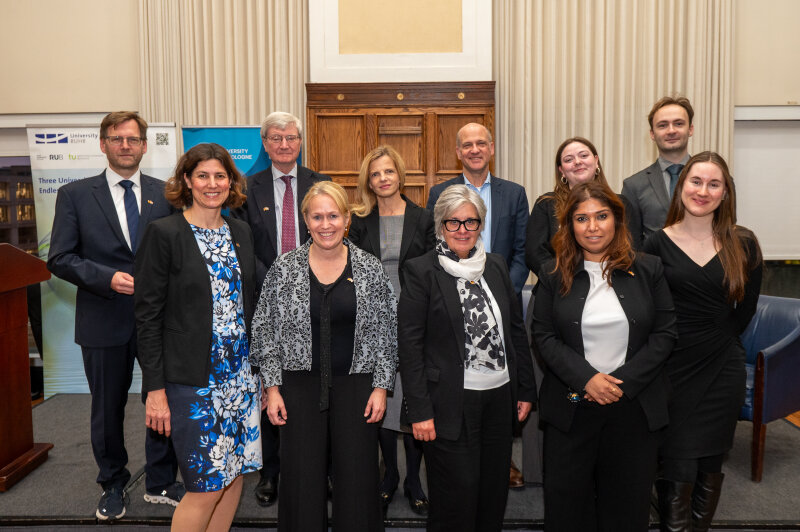
Washington, D.C., October 28, 2026 – The University Alliance Ruhr (UA Ruhr) North America and the University of Cologne New York Office launched their new event series, Democracy and Diplomacy: German-US Dialogues on Governance and the Rule of Law, with an inaugural gathering at the National Press Club in Washington, D.C., on October 28 supported by the German Center for Research and Innovation (DWIH) New York.
Bringing together representatives from academia, diplomacy, policy, and civil society, the event explored the challenges facing democratic institutions in Germany and the United States and the role of research, education, and international cooperation in strengthening democratic resilience.
The initiative was conceived against the backdrop of several significant milestones: the 250th anniversary of the United States Declaration of Independence, the 20th anniversary of the NRW School of Governance at the University of Duisburg-Essen, and the establishment of the Adenauer School of Government at the University of Cologne.
Designed as a long-term platform for transatlantic exchange, the series seeks to connect academic research with policy discussions and strengthen the role of universities as partners in science diplomacy.
Shared Democratic Values in a Changing Transatlantic Relationship
The evening opened with remarks by Dr. Martin Thümmel, Deputy Chief of Mission at the German Embassy in Washington, D.C., followed by welcomes from Priya S. Nayar, Executive Director of University Alliance Ruhr North America, and Eva Bosbach, Executive Director of the University of Cologne New York Office.
In his remarks, Dr. Thümmel reflected on the distinct constitutional traditions of Germany and the United States and their shared commitment to democratic governance. While the American constitutional tradition places particular emphasis on individual liberty and checks and balances, Germany's postwar constitutional order is rooted in human dignity, institutional stability, and safeguards against the erosion of democracy from within.
Against a backdrop of geopolitical uncertainty, technological transformation, and shifting public attitudes, his remarks raised a central question for the evening: How can Germany and the United States sustain their partnership when democratic values and institutions face increasing pressures on both sides of the Atlantic?
Democratic Resilience Requires More Than Strong Institutions
The subsequent panel brought together leading scholars from the University of Duisburg-Essen and the University of Cologne:
- Prof. Dr. Andreas Blätte, Director of the NRW School of Governance, University of Duisburg-Essen
- Prof. Dr. Karen Shire, Vice Rector University Culture, Diversity and International Affairs, University of Duisburg-Essen
- Prof. Dr. Johanna Hey, former Vice-Rector of the University of Cologne and associated scholar of the Adenauer School of Government
The discussion was moderated by Dr. Steven Sokol, President of the American Council on Germany.
The panel examined the growing pressures on democratic institutions, including political polarization, declining public trust, disinformation, and challenges to the independence of courts, the media, and academic institutions.
Johanna Hey emphasized that constitutional safeguards depend not only on legal frameworks but also on the willingness of political actors and citizens to respect institutional independence and accept democratic processes. Independent courts, professional civil services, prosecutors, and trustworthy public institutions form an interconnected system of accountability essential to democratic governance.
Andreas Blätte addressed the ways in which populist movements can challenge democratic institutions and undermine confidence in established sources of knowledge. At the same time, he pointed to expressions of civic solidarity, political participation, and collective action as important signs of democratic resilience.
A recurring theme was the distinction between productive political disagreement, which is essential to democracy, and polarization that erodes mutual trust and weakens the foundations of democratic debate.
Inequality, Social Cohesion, and Democratic Participation
The discussion also explored the relationship between socioeconomic conditions and democratic stability.
Karen Shire highlighted how rising inequality, economic insecurity, and declining confidence in future opportunities can weaken social cohesion and solidarity across different groups. Concerns about housing affordability, economic prospects, and the ability to build a secure future were discussed as factors contributing to political resentment, particularly among younger generations.
The panel considered how democratic institutions and established political parties can respond more effectively to citizens' lived experiences and changing expectations.
Rather than relying exclusively on technocratic solutions, the speakers emphasized the importance of meaningful public participation in policymaking. Blätte advocated for approaches to participatory governance that bring citizens into dialogue with policymakers and enable research-based insights to inform practical, socially responsive solutions.
Universities as Partners in Democratic Governance
A central focus of the evening was the responsibility of universities in supporting democratic societies.
Drawing on the expertise of the NRW School of Governance and the Adenauer School of Government, the panel explored how academic institutions can connect rigorous research with public policy, civic engagement, and democratic education.
Universities were presented not only as producers of evidence-based knowledge but also as spaces where difficult societal questions can be examined openly, competing perspectives can be discussed constructively, and future generations can develop the skills necessary for democratic participation.
The speakers also addressed pressures on academic freedom and the importance of protecting independent research, particularly in politically contested fields.
The discussion underscored the value of sustained engagement among researchers, policymakers, public institutions, and citizens. Such exchanges can help ensure that academic knowledge contributes to democratic practice while remaining responsive to the needs and experiences of society.
Artificial Intelligence and the Future of Democratic Dialogue
The panel further considered the growing influence of digital media and artificial intelligence on democratic discourse.
Social media platforms were discussed as environments that can accelerate disinformation, amplify political frustration, and reinforce polarization, while also providing important channels for information, participation, and civic engagement.
The speakers emphasized the need to strengthen media literacy and responsible AI competencies, particularly within educational institutions. Rather than viewing emerging technologies exclusively as threats, the discussion highlighted the importance of understanding their societal implications and equipping citizens to engage with them critically.
Interpersonal exchange, open dialogue, and the ability to engage across differences were identified as essential complements to technological and regulatory responses.
Building a Lasting Platform for Transatlantic Exchange
The inaugural gathering marked the beginning of a broader initiative by University Alliance Ruhr North America and the University of Cologne New York Office to establish a sustained forum for German-American dialogue on governance, democratic institutions, and the rule of law.
Anchored in the research expertise of the NRW School of Governance at the University of Duisburg-Essen and the Adenauer School of Government at the University of Cologne, the series aims to bring scholars into closer conversation with diplomatic representatives, policymakers, civil society organizations, and other stakeholders.
The initiative also highlights the role of North Rhine-Westphalia's universities in addressing international policy challenges and contributing to science diplomacy through research-based exchange.
Future editions of Democracy and Diplomacy are envisioned as opportunities to deepen institutional partnerships, involve early-career researchers, and expand the network of participants engaged in transatlantic cooperation.
The October 28 discussion concluded with a shared recognition that democratic resilience cannot be taken for granted. It requires independent institutions, public trust, social and economic responsiveness, civic participation, and a willingness to engage constructively across political and national differences.
By creating a space for sustained exchange between research and policy, Democracy and Diplomacy seeks to contribute to that ongoing effort and reinforce the importance of academic cooperation in the German-American relationship.

About University Alliance Ruhr
University Alliance Ruhr (UA Ruhr) is the strategic partnership of Ruhr University Bochum, TU Dortmund University, and the University of Duisburg-Essen. Through its North American office in New York, UA Ruhr promotes transatlantic research cooperation, academic exchange, innovation, and institutional partnerships, connecting the research strengths of Germany's Ruhr region with universities and partners across North America.
